Speaking Engagements
Here you will find recordings of Wayland calling in from prison, as well as flyers from his speaking engagements over the years.
If you would like to host Wayland by phone in your classroom, at your next group meeting, or otherwise, please reach out to us!
2026
Wayland’s response to the drug epidemic and cell phone smuggling into the prison system
Wayland’s take on the 13th Amendment, in relation to prison labor being mentioned in the documentary "The Alabama Solution”.
the Black Lives Matter movement: its victories, shortcomings, and legacy
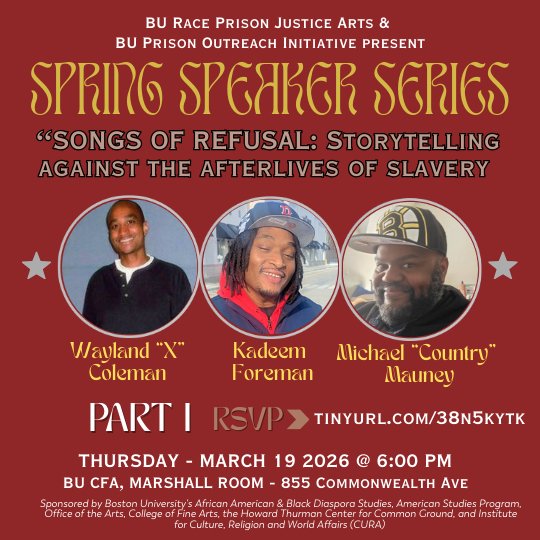
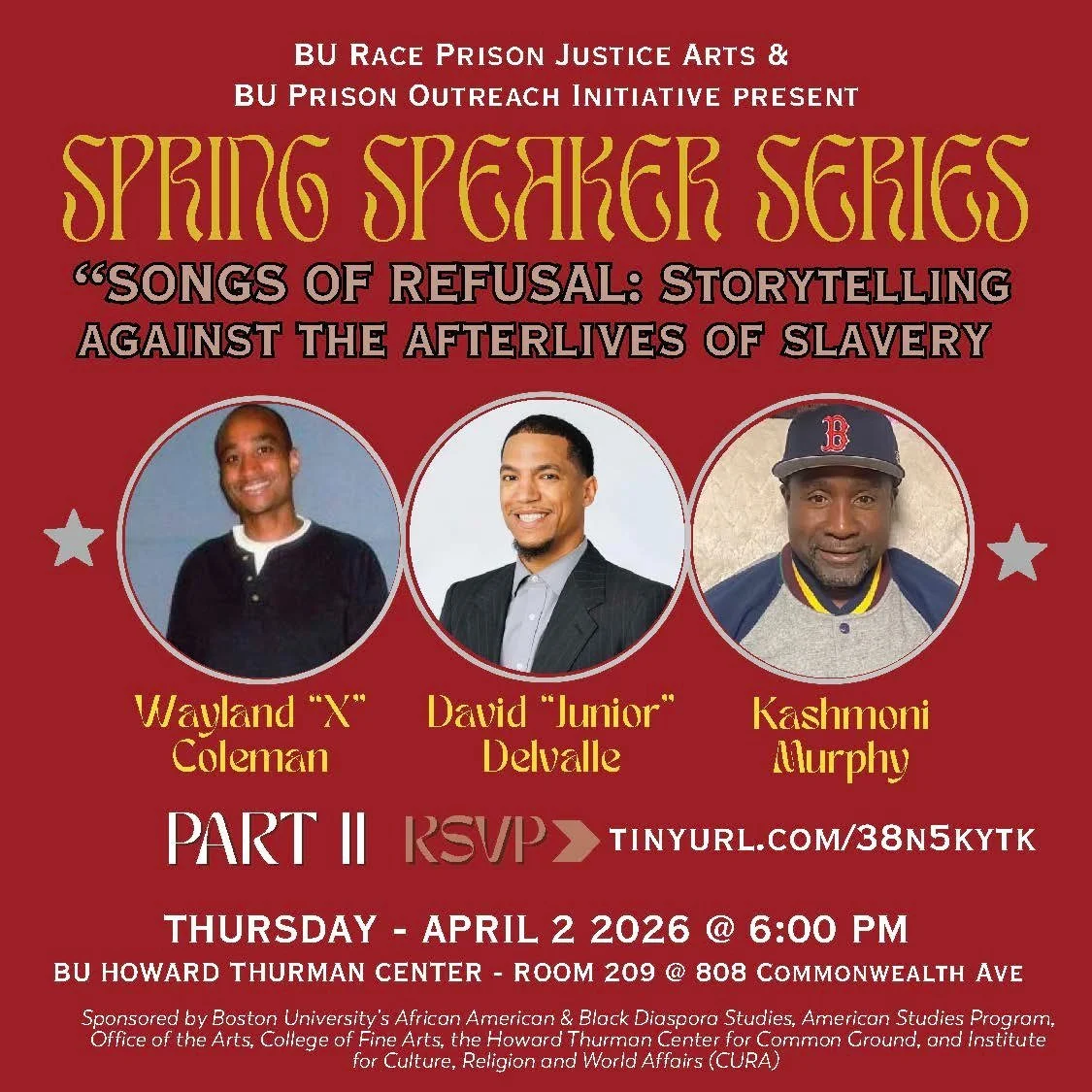
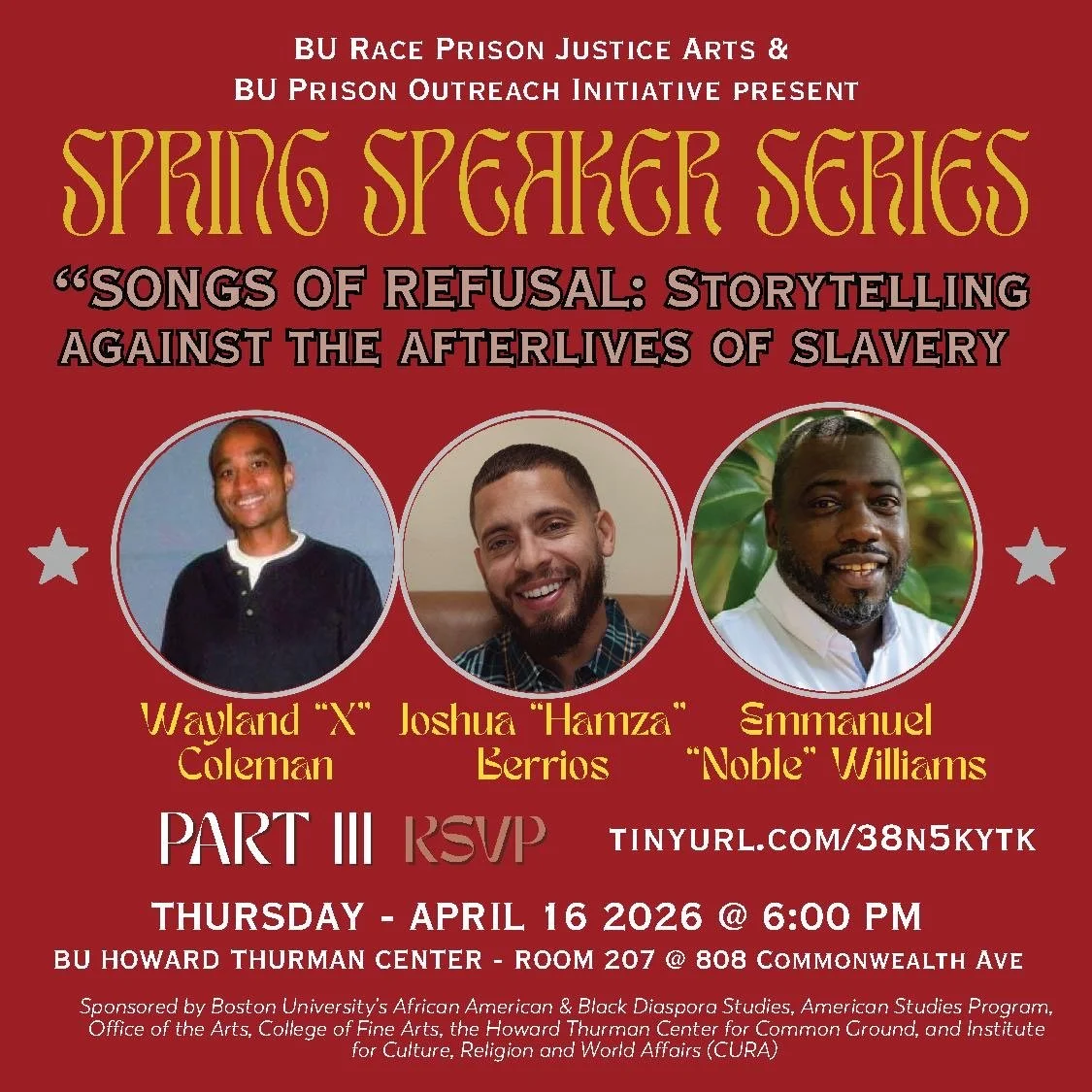
Wayland speaking on MCI Norfolk’s Strip Search Policy, following zoom meetings with legal representatives
2025
-September 9 - “Songs of Defiance: Healing and Resistance Behind Prison Walls”, “Rise Up Conference”, College Park, Maryland
-September 18 - IMAJIN Discussion with Mary Cohen
-October 14 - Presentation for New England Foundation for the Arts
2023
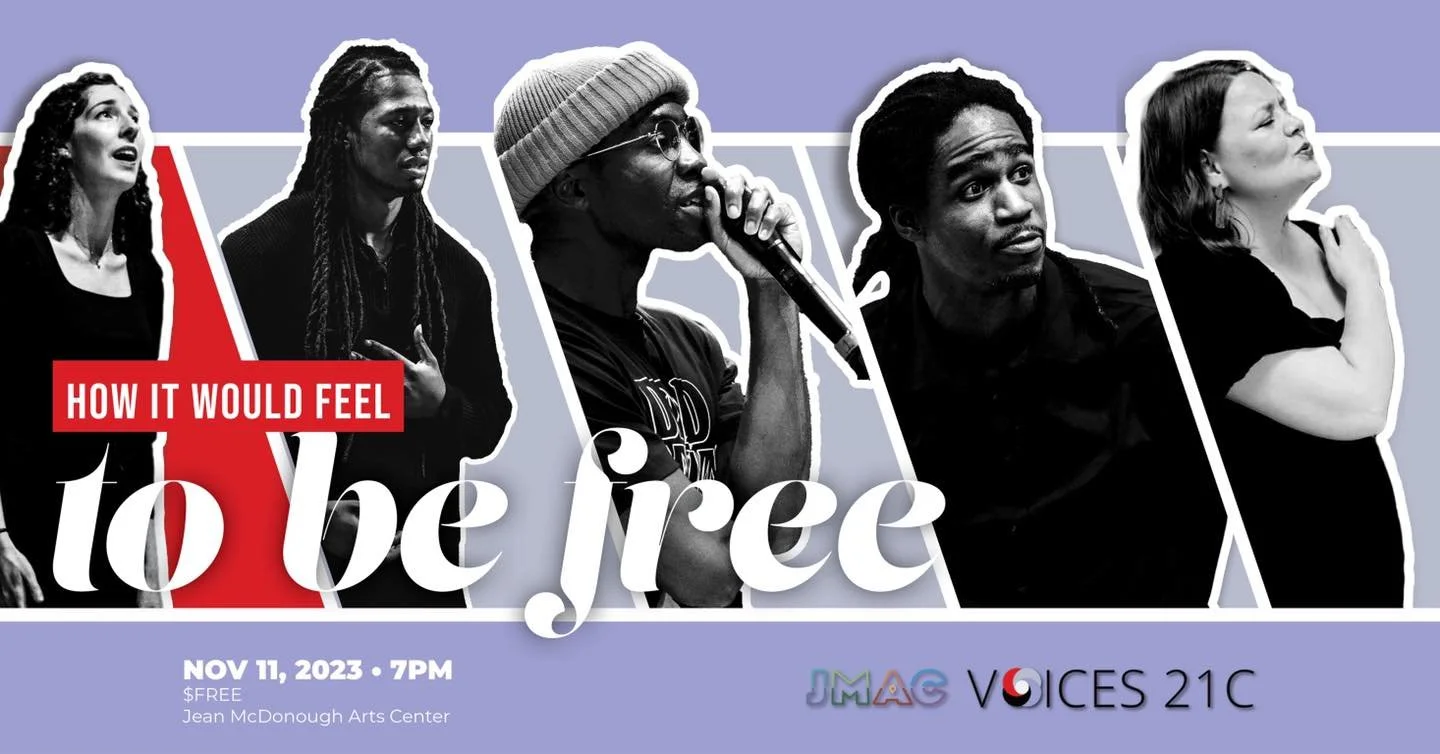
“How It Would Feel to be Free” took place at the Jean McDonough Arts Center in Worcester, Wayland’s hometown. The performance drew a packed house, featuring Wayland’s original visual art, music, and writing in addition to audio recordings of his poetry and artistic descriptions. Among the audience were community organizers advocating for legislation to reform criminal justice policy in Massachusetts.
2021
The Choral Commons: “Singing in Prisons” Roundtable
-
My name is Wayland X Coleman, I’m an incarcerated activist, I’ve been incarcerated for 24 years. I graduated from the Boston University program at MCI Norfolk with honors, and earned my bachelor's degree in 2018.
Today I’m going to talk about my experiences, and other incarcerated peoples’ experiences with the Empowering Song class that was introduced by Professor de Quadros through the Boston University program. I hope that this discussion will do enough justice to convince educators to create those kinds of spaces in the prison, at least until we can abolish them.
First, I want to thank André for the opportunity to extend my voice and our voices beyond the prison walls. While the body can be caged and hidden away from you, the mind is the part of a person that cannot be restrained by physical means. I took seven semesters of the Empowering Song course through the BU Program at Norfolk. This class emphasized minds, and the development of the individual. André used to tell us that he was giving us new brains, and that once we were done with the course; we would all walk away with brand new brains. So he explained to us that music literally requires peoples’ brains. So that was his philosophy to us in the class. The course material was unique from any other class setting, but it didn’t involve textbooks. It wasn’t “read a book and then write an essay about it.” Instead, we were the material. We were the books. Our voices, our minds, our bodies, our ears, tell everyone’s life story. It was our life stories that provided the material for the course.
Now how those life stories came to be expressed through the class, and pulled out of us to become the material, is the genius of the Empowering Song approach, I believe. We would often arrive at the classroom ahead of the professors, and we would free up the floor space by moving all of the tables and desks out of the way. We’d create a circle wall to wall with all of the chairs, and when the professors walked into the classroom, the very first thing they would do is walk around and greet everyone individually.
Literally, they would spend their moment with every single person in that room, individually. This gesture shows us that each person matters. Everyone was important and worthy of recognition. That was important because a lot of us don’t believe that the people in our free society deem us worthy of their recognition. So that was important because even if only for a moment, only for several seconds, that moment no matter how brief my time was. That was my moment to shake a hand or to have someone smile at me, make eye contact. These things the free society might see as minuscule, but to us it matters. In the 1800’s, an enslaved person being recognized by anyone for any amount of time would’ve mattered to them, so that’s how it matters to us.
After the greetings, we would form a circle holding hands. André, Emily, or Trey, or Jamie when they were there, would start us off with a song they would teach us. Making us hold hands brought us out of our comfort zones. America has a culture of hyper-masculinity that acts as a barrier to growth. The professors and the guests they brought in with them were taking a direct shot at that toxic culture. To hold hands, give someone a hug, or sit next to someone you don’t know. They made us stand face to face with someone and literally stare into their eyes. And they would say “sing a song” while you’re making eye contact, so it was very uncomfortable and difficult for many of us, but by making us step outside of our comfort zones, they were bringing out our vulnerabilities and reaching for the parts of our character that get suppressed in these kinds of institutions.
The course was composed of several activities combining music, art, and drama. André, Trey, and Emily were bringing the music, Jen brought in the art and Judy brought in the drama. Together all three of those aspects of expression were incorporated into the classroom. professors would start the course by introducing a theme for the semester. It's important to talk about the function of the theme if anybody’s going to design these types of spaces. For example, “Neither I Have Wings to Fly” would be a theme, and those words would be a focal point for the semester. We’d have to take that theme and relate it to our lives and our conditions.
For example, if I were to say “Deeper than water is my wings,” when you ask how that theme applies to me, “deeper than water” would be how I fly above the suffering that I endure, the struggle I endure, the solitary confinement they put me in, “deeper than water” would be my wings to fly above that.
When you look at the themes of the class, the reason themes are important is because when we have to relate the themes to our lives, there are a lot of people in the prison who don’t have wings. They don’t have a support system or means to escape or get beyond something. A lot of that was being expressed in the classroom. Again, these vulnerabilities were coming up front where we were able to discuss them.
People were breaking off into pairs, and the care André would take towards people was phenomenal because we were able to discuss these vulnerabilities and it would help people grow. These themes became part of not just some random work that was selected, but a direct part of who we were. We were coming to understand ourselves through these themes.
Along with that we had journal entries, which were homework assignments where we were asked to share a deep thought. “Write a poem.” “Create a song.” or “Make some kind of art.” Sometimes the journal entry would contain a task that’s embarrassing, and outside of the normal prison culture. For example, we had to write a song or poem, sing it to an incarcerated stranger, and then write about the experience for our homework assignment. I thought that was unique because not only were we encouraged to step outside of our comfort zones inside the classroom, we were also learning to step outside of them outside of the classroom and make free expression part of our daily lives.
There are so many different activities and it’s hard to remember them all, but each class will be split into small groups and each group would have to create a skit. This was the drama part, the performance pieces. They would give us ten minutes to create a performance piece that would involve a word, a song, or a still image (tableau). I particularly loved the creation of the still images because they were unique, I had never done anything like them. The five of us would contort ourselves the best we could, and freeze into those positions while everyone else in the classroom examined us and tried to figure out what the hell we were doing. they were often expressions we were trying to get out. we would get together and try to express a thought or an emotion through these still shots. it introduced us to things that weren’t being introduced to us on the regular inside of the prison.
These group activities were expressions of our lives and stories. The scenes we created were based on somebody’s story, somebody’s life. Everything was always personal with us. The Empowering Song course was constantly pushing us to create, every minute of class. It was really developing our brains and our creative abilities.
André would say “Everybody take a seat, pull out a pen and paper and write a poem fresh off the mind.” We’d have three minutes and after that we would perform the poem. [Prison phone: “You have one minute left.”]
So this phone is gonna hang up— what I want to say is that they created an environment for us to express our fears and insecurities, to develop our creative minds, that no other program inside the prison can do for us. People from different gangs in neighborhoods were working together in the classroom, they were squashing their beef inside the classroom and outside. The students in the class were applying the lessons during celebrations of Martin Luther King Day, and I think the Empowering Song space helped us all to come to the truth about who we are and what we want out of life.
I think that exposing us to our own suppressed vulnerabilities helped us to create and communicate better with our loved ones, because we didn’t need to hide anymore behind the hyper-masculine attitudes that shape the culture of incarceration—
[Prison phone cuts Wayland off.]